

Medical billing represents the lifeblood of healthcare organizations, serving as the critical bridge between patient care delivery and financial sustainability. As healthcare providers navigate increasingly complex regulatory requirements, payer policies, and technological advancements in 2026, understanding the intricacies of revenue cycle management has never been more essential. Organizations that master these processes not only improve their financial health but also enhance patient satisfaction and operational efficiency across their entire practice.
The Foundation of Healthcare Revenue Cycle Management
Medical billing forms the cornerstone of healthcare revenue cycle management, encompassing the entire process from patient registration to final payment collection. This systematic approach ensures healthcare providers receive appropriate compensation for services rendered while maintaining compliance with federal regulations and payer requirements.
The process begins the moment a patient schedules an appointment and extends through claim submission, adjudication, and payment posting. Each step requires meticulous attention to detail and coordination between clinical staff, billing specialists, and administrative personnel. Organizations that streamline these workflows experience measurable improvements in cash flow and reduced administrative burden.
Critical Components of Modern Medical Billing Systems
Today's medical billing infrastructure relies on several interconnected elements that work together to create efficient revenue cycles:
- Patient registration and insurance verification to ensure accurate demographic and coverage information
- Medical coding using standardized systems like ICD-10, CPT, and HCPG codes
- Charge capture to document all billable services and procedures
- Claims submission through electronic or paper formats to insurance payers
- Payment posting and reconciliation of received payments
- Denial management and appeals processes for rejected claims
- Patient billing for remaining balances after insurance payments
The CPT coding resources provided by the American Medical Association offer comprehensive guidance on proper code selection and documentation requirements, which directly impacts reimbursement accuracy.

Organizations investing in revenue cycle management solutions position themselves to capture revenue more effectively while reducing the time staff spends on manual processes. These systems integrate clinical documentation with billing operations, creating seamless workflows that minimize errors and accelerate payment cycles.
Compliance and Regulatory Requirements in Medical Billing
Healthcare organizations must navigate a complex landscape of federal, state, and payer-specific regulations that govern billing practices. The Centers for Medicare & Medicaid Services establishes baseline requirements that extend throughout the industry, while individual commercial payers add their own policies and documentation standards.
Understanding No Surprises Act Protections
The No Surprises Act protections implemented by CMS have fundamentally changed how providers handle out-of-network billing situations. This legislation protects patients from unexpected medical bills in emergency situations and for certain non-emergency services at in-network facilities.
Compliance requires healthcare organizations to:
- Provide good faith estimates for uninsured and self-pay patients
- Implement compliant billing practices for out-of-network services
- Establish processes for independent dispute resolution
- Maintain detailed documentation of patient consent and disclosures
- Update internal systems and staff training regularly
Organizations failing to comply face significant financial penalties and reputational damage. The billing and collections guidelines from the American Hospital Association emphasize equitable treatment of all patients while maintaining regulatory compliance.
Credentialing and Professional Development
Medical billing professionals require specialized knowledge and ongoing education to maintain accuracy and compliance. The industry recognizes numerous professional credentials that validate expertise in coding, billing, and revenue cycle operations. These professional credentials span various specialties and experience levels, allowing staff to demonstrate competency in specific areas.
| Credential Type | Focus Area | Typical Requirement |
|---|---|---|
| CPC (Certified Professional Coder) | Outpatient coding | Exam + 2 years experience |
| CCS (Certified Coding Specialist) | Inpatient coding | Exam + clinical knowledge |
| CPMA (Certified Professional Medical Auditor) | Compliance auditing | Prior coding certification |
| CRCS (Certified Revenue Cycle Specialist) | Revenue cycle operations | Exam + operational knowledge |
Investing in staff development and certification programs creates measurable returns through improved claim acceptance rates and reduced error rates across the revenue cycle.
Common Challenges and Optimization Strategies
Healthcare organizations consistently face obstacles that impede efficient revenue collection and strain operational resources. Identifying these challenges and implementing targeted solutions separates high-performing organizations from those struggling with cash flow issues.
Denial Management and Prevention
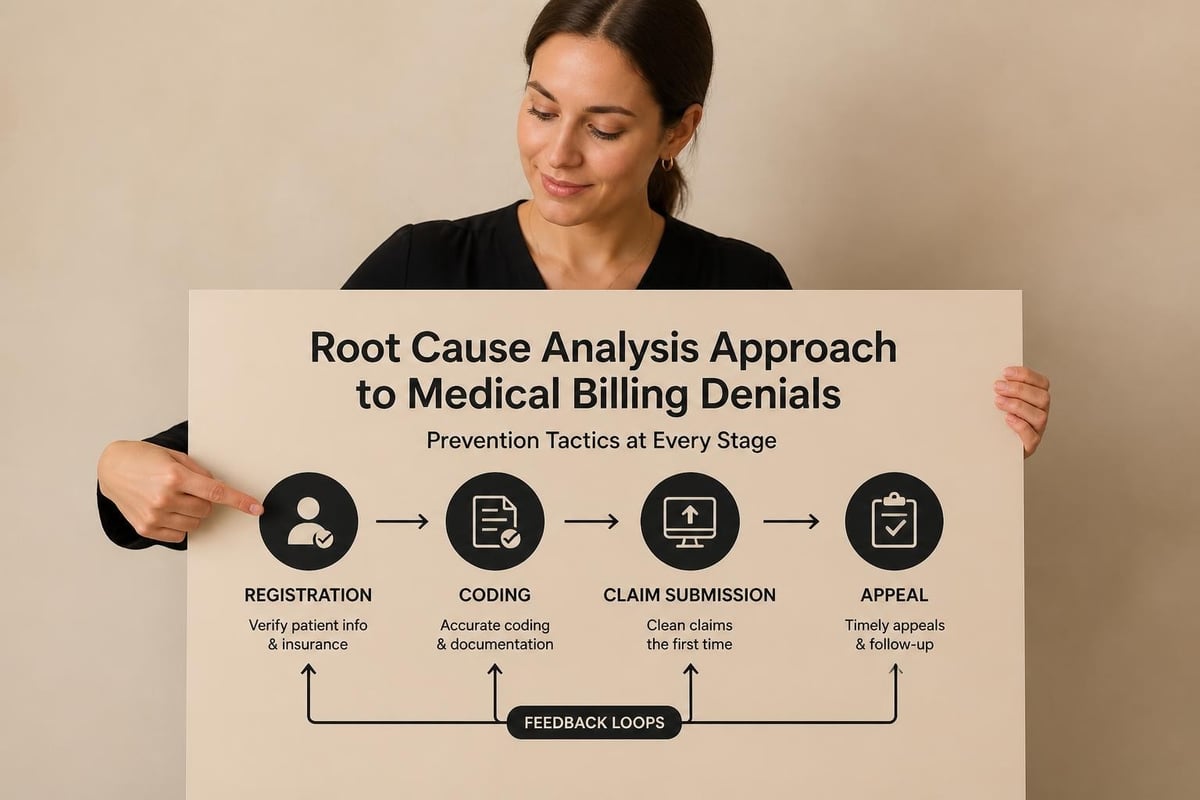
Claim denials represent one of the most significant threats to healthcare revenue, with industry studies indicating denial rates ranging from 5% to 25% depending on specialty and payer mix. Each denied claim requires additional staff time to research, appeal, and resubmit, creating compounding costs beyond the delayed payment.
The most common denial categories include:
- Coding errors or missing documentation
- Registration mistakes and incorrect patient information
- Lack of prior authorization or referral
- Timely filing limit violations
- Medical necessity determinations
- Duplicate claim submissions
Organizations can dramatically reduce denials by implementing front-end verification processes and real-time eligibility checking. When denials do occur, robust tracking systems identify patterns that enable proactive prevention strategies. Many providers find that addressing common medical billing mistakes through standardized workflows eliminates recurring issues.
Technology Integration and Automation
Modern medical billing demands sophisticated technology platforms that integrate clinical documentation, practice management, and revenue cycle functions. Organizations still relying on manual processes or disconnected systems experience higher error rates, slower payment cycles, and increased labor costs.
Automation opportunities exist throughout the revenue cycle:
- Eligibility verification through real-time payer connections
- Charge capture via integrated EHR documentation
- Claim scrubbing using rules-based validation engines
- Payment posting through electronic remittance advice processing
- Patient statement generation with automated payment plans
- Analytics and reporting for performance monitoring
The time savings achieved through automation enable billing staff to focus on complex cases, payer relationship management, and strategic revenue optimization rather than repetitive data entry tasks.
Underpayment Recovery and Revenue Integrity
Beyond preventing denials, healthcare organizations must ensure they receive full contractual payment for services rendered. Underpayments occur when payers reimburse below contracted rates, apply incorrect fee schedules, or fail to properly adjudicate claims according to negotiated terms.
Identifying and Recovering Underpaid Claims
Many healthcare providers lack the internal resources or expertise to systematically audit payments against contractual agreements. This creates significant revenue leakage that compounds over time. Organizations should implement regular contract compliance auditing to identify discrepancies and recover underpayments.
Effective underpayment recovery programs include:
- Contract modeling and rate validation systems
- Systematic payment variance analysis
- Documented appeal processes with payers
- Escalation procedures for unresolved disputes
- Performance tracking and trend analysis
Healthcare providers working with specialized firms can efficiently recover underpayments without expanding internal staffing. These partnerships often operate on contingency models, aligning incentives around successful recovery outcomes.
| Underpayment Category | Average Recovery Rate | Time to Resolution |
|---|---|---|
| Incorrect fee schedule | 85-95% | 30-60 days |
| Missing contractual adjustments | 70-80% | 60-90 days |
| Bundling errors | 60-75% | 90-120 days |
| Modifier payment issues | 65-80% | 60-90 days |
Organizations that identify healthcare underpayment issues early and address them systematically protect their revenue streams and ensure financial sustainability.
Advanced Analytics and Performance Monitoring
Data-driven decision making separates leading healthcare organizations from those struggling with revenue cycle challenges. Medical billing generates enormous volumes of data that, when properly analyzed, reveal opportunities for operational improvement and revenue enhancement.
Key Performance Indicators for Medical Billing Operations
Healthcare executives should monitor specific metrics that indicate revenue cycle health and identify emerging issues before they impact cash flow. These measurements provide objective benchmarks for performance evaluation and continuous improvement initiatives.
Financial metrics include:
- Days in accounts receivable
- Collection rate percentage
- Net collection rate
- Cost to collect
- Bad debt percentage
Operational metrics include:
- Clean claim rate
- Denial rate by payer and category
- Appeal success rate
- Coding accuracy percentage
- Claim submission lag time
Organizations leveraging healthcare data analytics gain visibility into performance trends and can implement targeted interventions when metrics deviate from established benchmarks. Real-time dashboards enable management teams to monitor operations daily rather than relying on month-end reporting cycles.

Benchmarking and Industry Comparison
Understanding how your organization's medical billing performance compares to industry standards helps identify improvement opportunities and validate investment decisions. While performance varies by specialty, practice size, and payer mix, general benchmarks provide useful reference points.
Leading organizations in 2026 typically achieve:
- Clean claim rates above 95%
- First-pass resolution rates exceeding 85%
- Days in AR below 35 days
- Net collection rates above 95%
- Denial rates under 5%
Organizations falling below these benchmarks should evaluate their processes, technology platforms, and staffing models to identify root causes. Sometimes, engaging external expertise through consulting services provides the objective assessment and specialized knowledge needed to transform underperforming revenue cycles.
Optimizing Patient Financial Experience
While medical billing traditionally focuses on payer interactions and claim processing, the patient financial experience has emerged as a critical component of overall revenue cycle success. As patient responsibility portions increase through high-deductible health plans and rising copayments, collecting from patients becomes as important as optimizing payer reimbursement.
Transparent Communication and Financial Counseling
Patients increasingly expect transparency regarding healthcare costs and their financial obligations. Organizations that provide clear estimates, explain billing processes, and offer flexible payment options experience higher collection rates and improved patient satisfaction scores.
Best practices for patient financial engagement include:
- Providing cost estimates during scheduling and registration
- Verifying insurance coverage and explaining benefit limitations
- Discussing payment options before service delivery
- Offering financial assistance programs for qualifying patients
- Sending clear, itemized statements with payment instructions
- Establishing convenient payment channels including online portals
The streamlined billing processes that improve cash flow also enhance patient experience by reducing confusion and frustration around medical bills.
Payment Plans and Alternative Solutions
Traditional medical billing often takes an all-or-nothing approach to patient collections, demanding full payment or offering limited flexibility. Modern patient financial management recognizes that structured payment plans and alternative solutions serve both organizational and patient interests.
Healthcare providers should consider:
- Automated payment plan enrollment at point of service
- Interest-free payment options for balances above thresholds
- Integration with third-party financing programs
- Payment plan management through patient portals
- Proactive outreach for accounts approaching delinquency
These approaches improve collection rates while maintaining positive patient relationships, which increasingly impacts online reviews, referral patterns, and overall market reputation.
Future Trends Shaping Medical Billing
The medical billing landscape continues evolving rapidly as technology advances, regulations change, and market dynamics shift. Organizations that anticipate these trends and adapt proactively position themselves for sustained success in an increasingly competitive healthcare environment.
Artificial Intelligence and Machine Learning Applications
AI-powered solutions are transforming medical billing operations by automating complex decision making, predicting payer behavior, and identifying optimization opportunities that human analysis might miss. These technologies analyze historical patterns to recommend optimal coding choices, predict denial likelihood, and prioritize work queues based on revenue potential.
Applications gaining traction in 2026 include:
- Autonomous medical coding from clinical documentation
- Predictive analytics for denial prevention
- Natural language processing for documentation improvement
- Robotic process automation for repetitive tasks
- Machine learning models for underpayment detection
Organizations implementing automation and integration solutions experience measurable improvements in accuracy, speed, and resource utilization across their revenue cycles.
Value-Based Care and Alternative Payment Models
The ongoing transition from fee-for-service to value-based reimbursement fundamentally changes medical billing requirements. Organizations participating in bundled payments, shared savings programs, and capitated arrangements need different capabilities than those operating purely in traditional fee-for-service environments.
This shift requires:
- Episode-based tracking and reporting
- Quality measure documentation and submission
- Risk adjustment and hierarchical condition category coding
- Care coordination documentation
- Population health analytics
Medical billing systems must evolve to support these alternative models while maintaining traditional claim processing capabilities during the transition period. Organizations can access specialized medical coding expertise to ensure compliance across multiple payment methodologies.
Strategic Vendor Selection and Partnership Models
Few healthcare organizations possess all the internal expertise, technology, and resources needed to optimize medical billing operations independently. Strategic partnerships with specialized vendors, technology providers, and consulting firms enable organizations to access capabilities that would be prohibitively expensive to develop internally.
Evaluating Medical Billing Service Providers
When considering outsourced medical billing services or revenue cycle management partners, healthcare organizations should conduct thorough due diligence to ensure alignment with organizational goals and culture. Independent vendor selection guidance helps practices navigate the crowded marketplace and identify partners with proven track records.
Critical evaluation criteria include:
| Evaluation Factor | Key Considerations | Weight |
|---|---|---|
| Technology platform | Integration capabilities, reporting, scalability | High |
| Staff expertise | Certification levels, specialty knowledge, training | High |
| Pricing model | Transparency, alignment with outcomes, total cost | High |
| Performance guarantees | Metrics commitment, accountability structure | Medium |
| Implementation support | Transition planning, training, ongoing support | Medium |
| Client references | Similar organizations, verifiable results | High |
Organizations benefit from reviewing comprehensive billing resources that provide objective comparisons and user ratings of various service providers.
Performance-Based Partnership Models
Traditional medical billing outsourcing arrangements typically charge percentage-of-collections fees or per-claim rates regardless of outcomes. More sophisticated performance-based models align vendor incentives with organizational objectives by tying compensation to measurable improvements in key metrics.
These arrangements might include:
- Baseline performance establishment with improvement targets
- Tiered pricing based on achievement of collection goals
- Shared savings models for underpayment recovery
- Outcome-based bonuses for denial reduction
- Risk-sharing arrangements for AR reduction
Performance-based consultancies focus on delivering tangible results rather than simply performing services, creating partnership dynamics that drive continuous improvement and sustained value creation.
Mastering medical billing operations requires balancing regulatory compliance, technological capabilities, staff expertise, and patient-centered approaches to create sustainable revenue cycles. Organizations that invest in optimizing these processes see improved financial performance, reduced administrative burden, and enhanced operational efficiency. Nero and Associates, Inc. specializes in healthcare revenue cycle management solutions that help organizations eliminate manual processes, increase revenue, and achieve measurable bottom-line improvements through performance-based consulting and advanced automation technologies. Contact our team today to discover how we can transform your revenue cycle operations and deliver sustainable financial results.